
By Cathy Crim
Back in 2019, every day was a bad hair day for our 10-year-old SFT Polly. For several months prior she had slowly, but continuously, lost body hair, which resulted in a very thin and rough feeling coat. Although she showed no other symptoms, this madcap, a generally healthy girl, was showing a worrisome indication that her body was not functioning properly.
Our wonderful veterinarian, Dr. Bettye Hooley, tested Polly for all the most obvious diseases and conditions with such side effects. And although she was shown to have mild low thyroid function, she was prescribed medication. But her coat continued to deteriorate.
What could be causing this continual hair loss and its poor condition? Polly’s happy behavior, energy level, and appropriate weight continued as it always had – Fox Terrier to the core!
Dr. Hooley did another full assessment, including rechecking for worms (negative, as expected). What else was Polly exposed to, either in her diet or supplements, or in her external environment?
We took a hard look at her diet. She was recieving excellent nutrition from reliable food sources. Check.
Then we looked at supplements – Homotoxicology and Quercenol for seasonal allergies; fish oil for skin, coat, joint, and some others. All good.
Then we looked at medications: Incurin for urinary incontinence…wait! Let’s stop there.
Incurin – A Possible Reason for General Alopecia
Over two years before, Polly began to leak urine as she rested after her dinner (and after a bathroom break). She was never incontinent during the night or any other time of the day. Only while “watching TV” after dinner, and generally nightly.
Incurin (see https://www.merck-animal-health-usa.com/species/canine/incurin-tablets) is a medication used to control estrogen-responsive urinary incontinence in spayed canines. After being administered a mild dose of a .5mg Incurin tablet every other day, she leaked no more. And, we observed absolutely no side-effects to this medication, which are listed as loss of appetite, vomiting, excessive water drinking, and swollen vulva.
Dr. Hooley had not seen a possible response to Incurin such as Polly’s, and, after all, she had been on the medication for at least two years. However, Dr. Hooley contacted the drug manufacturer. She was told that some dogs taking Incurin have shown general alopecia, although rarely. Immediately, Dr. Hooley removed Incurin from Polly’s regimen and replaced it with a Chinese Suo Quan Wan herbal incontinence formula.
For the next 18 months, Polly (at that time 12 years old) was given a 1/4 teaspoon dose of the Chinese formula twice daily. In all that time she showed no incontinence and her coat returned to a lush and healthy condition.
I loved to rub my hands through her coat and give her mini-massages on my travels around her body – I’m sure this touching is equally therapeutic for us both. And to return to a more revitalized coat was a pleasure.
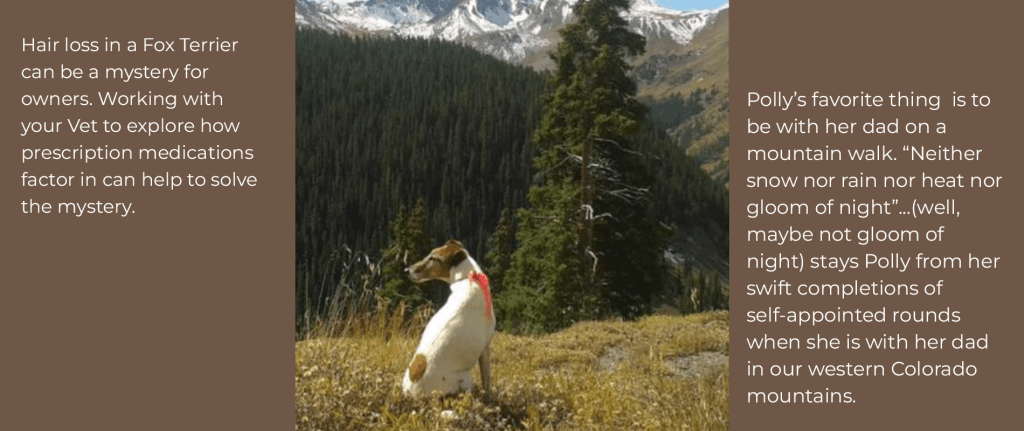
Polly’s most favorite thing in this whole wide world is to be with her dad on a mountain walk. “Neither snow nor rain nor heat nor gloom of night”…(well, maybe not gloom of night) stays this little 20-pound SFT from her swift completions of her self-appointed rounds when she is with her dad in our western Colorado mountains.
We don’t call her “Old Baldy” any longer….we reserve that name for her dad.
This article original appeared in the Spring 2021 edition of the All Things Fox Terrier newsletter.
 Fox Terrier Network
We love comments, but will review before posting for appropriateness.