
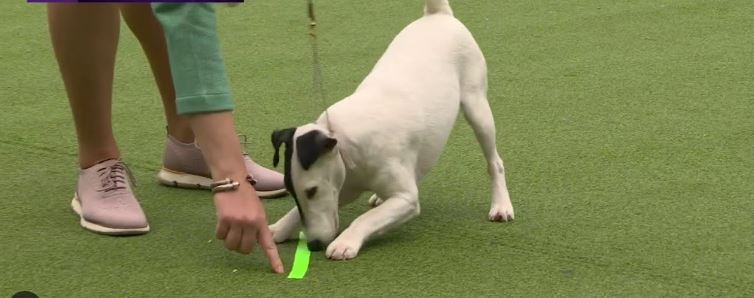
If you have been interested in obedience competition for your dog, here is a bit of information that may interest you. Several organizations offer obedience competition. The two most popular venues are the American Kennel Club (AKC) and the United Kennel Club (UKC).
AKC allows any dog 6 months or older who is registered with AKC or listed with the Canine Partners (mixed breeds) program to compete in Obedience trials. UKC allows all dogs registered with the UKC to compete in their events. Both venues offer 3 levels of competition and each level gets increasingly more difficult as the dogs progress.
Below is a table listing the levels and exercises for AKC and UKC competition.
American Kennel Club
| Novice (obedience training beginners) | Open (dogs who have earned the Novice title) | Utility (advanced obedience level)* |
|---|---|---|
| Heel on Leash and Figure Eight | Heel Free and Figure Eight | Signal Exercise |
| Heel Free | Drop on Recall | Scent Discrimination |
| Stand for Examination | Retrieve on Flat | Directed Retrieve |
| Recall | Retrieve Over High jump | Moving Stand and Examination |
| Long Sit (1 minute) | Long Sit (3 minutes) | Directed Jumping |
| Long down (3 minutes) | Handler is out of sight | |
| Long Down (5 minutes) | *See more below |
United Kennel Club
| Novice – for dogs beginning in obedience | Companion Dog Excellent– for dogs who have earned the Novice title | Utility – for dogs who are at the most advanced level of obedience training |
| Heel on Leash and Figure Eight | Heeling Off Leash | Directed Signal Retrieve |
| Off Leash Heeling Pattern | Off Leash Figure Eight Heeling Pattern | Scent Discrimination |
| Stand for Exam | Drop on Recall | Directed Marked Retrieve from Handler’s Side for Gloves |
| Recall Over High Jump | Dumb Bell Retrieve on Flat | Recalls With and Without a Dog Command |
| Long Group Sit (1 minute) | Dumb Bell Retrieve Over High Jump | Directed Jumping Over Wall and Bar Jumps |
| Honor Down (done while another team is performing their off leash heeling pattern) | Broad Jump | Heeling Pattern With Down, Sit and Come Signals |
| Honor Down |
The utility levels in both AKC and UKC require some advanced skills. Below is a description of them.
- Signal Exercise – no voice commands are given. The dog must respond correctly to hand signals for the sit, stand, stay, down and come.
- Scent Discrimination – tests the dog’s ability to find the handler’s scent among a pile of articles.
- Directed Retrieve – the dog must retrieve a glove and return it to the handler by following a directed signal.
- Moving Stand and Examination – tests the dog’s ability to stand for examination by the judge and return to the handler. The dog must also heel, stand and stay as the handler moves away.
- Directed Jumping – tests the dog’s ability to follow commands to move away from the handler, turn, sit and take whichever jump is indicated by the handler and then return to the handler.
For information about events, see the following links:
 Fox Terrier Network