
By Becky Heiner, Certified Professional Canine Fitness Trainer CPCFT at K9 Connections, Kaukauna, Wisconsin
Have you ever wondered how dogs like Asta (Thin Man) and Bella (Moonrise Kingdom) became the movie stars they are? How about the dogs that made the World Team in agility? Or even the Search And Rescue K9 heros?
At first glance, their initial training might seem to be vastly different. The truth is, every one of them started out as a puppy; you know, those adorable little creatures that have accidents in the house, cry through the night and destroy your favorite pair of Prada’s.
Every one of those “super” dogs were adorable, naughty puppies but through basic training became familiar with strangers, new environments and learned a few basic commands. Hmmm, that kind of sounds like good things for every dog to know, right?
Harness FT Energy by Committing to Training
Training a puppy for performance starts even before you bring the pup home. Choose a curious, outgoing puppy that has been somewhat socialized. A well-socialized puppy with a good temperament will make training much easier and faster.
However, most of us didn’t have the opportunity to pick the perfect puppy from someone who socialized them. Whether your dog is young, middle aged or older, a rescue, a retired show dog, or acquired as a family pet, every dog can benefit from a little training. Most of us didn’t get Fido with making the Agility World Team in mind.
However, most of us didn’t have the opportunity to pick the perfect puppy from someone who socialized them. Whether your dog is young, middle aged
or older, a rescue, a retired show dog, or acquired as a family pet, every dog can benefit from a little training. Most of us didn’t get Fido with making the Agility World Team in mind.
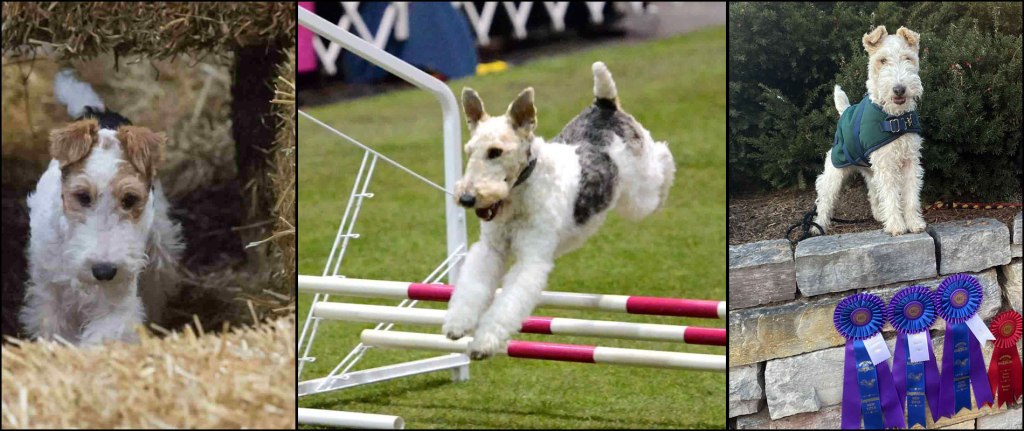
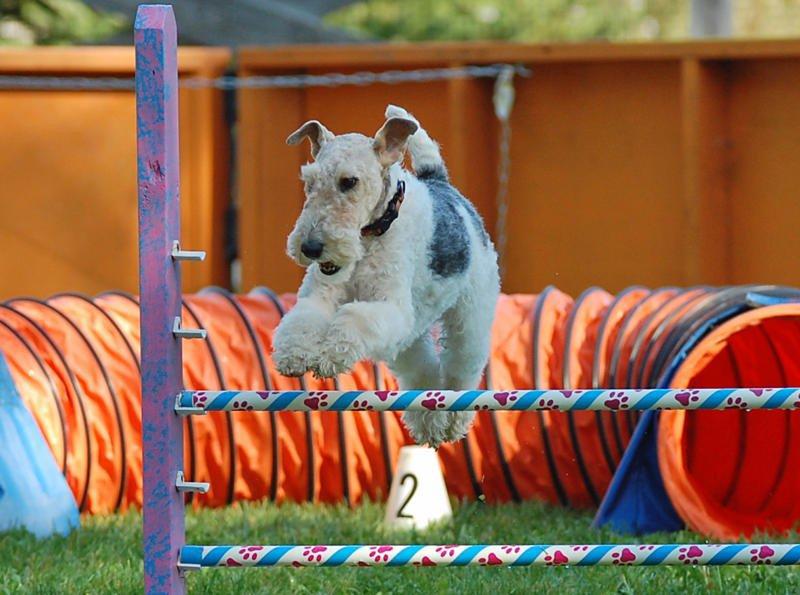
I started agility with my first Wire Fox Terrier as an avenue for him to release some of his Terrier puppy energy. Never in my wildest dreams did I think my first non-couch potato dog would end up going to the AKC/Eukanuba Agility Invitationals or become the #1 Wire Fox Terrier in AKC agility.
Neither did several puppy class trainers or later agility instructors who told me to get a different breed if I ever wanted to compete. The best advice I can give is to love your dog, adopt a winning attitude, commit to positive training methods and have fun. A whole new- world may just open up for you.
Socialize, Socialize, Socialize
For puppies, the first order of business is socialization. Let your pup meet as many men, women, children and dogs as possible. Diversify, introduce your dogs to tall, bearded men with funny looking hats, boisterous women with crazy glasses, children who are loud and energetic (as long as they respect your dog), and dogs of all shapes and sizes. Nursing homes are good places to frequent: your pup will brighten the day of the Senior Citizen residents and the dog will see wheelchairs and people with walkers and canes. The more dogs are exposed to different people and situations, the more comfortable they will be.
Socializing an Older Dog
Chewy.com has tips for socializing older dogs. Chewy notes, as you might expect, that older dogs are more difficult to socialize which may be expressed by showing fear toward unfamiliar humans. They advocate allowing for a slower socialization process that may include a visit to the dog park where you and your critter simply observe other dogs from a distance. This approach may also be useful with people. Visit a park but keep your dog isolated where he or she may observe humans engaging or at play. Slowly close the gap as your dog leads the way until the dog is comfortable making a new friend. Step and repeat. And always reward progress with a treat.
Slow the process down and create space if your dog shows a sign of stress. Stress indicators include:
- Yawning
- Seeing the whites of their eyes
- Lip licking
- Increased/unusual panting
- Growling
- Avoidance behaviors — turning away from the new thing, hiding behind you
Make Training a Game
Make training fun by using positive reinforcement training methods. Clicker training is a good place to start. Enroll in a clicker class or purchase one of the many good books on the subject. Reward every desired behavior your pup offers.
Timing is everything. When your dog does what you want, click or say “yes” and give a treat immediately. If using treats, have your treats in hand and ready to dispense. If you tell your young dog to sit and he responds by sitting down, and you fumble for a few seconds trying to retrieve a treat or a clicker, the dog will quickly focus on something else. He or she may look up at the sky or focus on some other interesting molecule and may be confused as to what the reward is for.
Use Operant Conditioning Techniques
Dogs learn faster what they figure out themselves. Let your dog figure out what you want, then reward quickly. An example of this is the game “101 things to do with a box.”
Place a box big enough for your dog to sit in on the floor. Set a goal, which may be you want the dog to sit in the box. Your pup’s curiosity will get the best of him and as he heads toward the box to check it out, click and treat. For example, a sniff of the box gets a click and treat. If the dog paws the box, click and treat. By now your dog is starting to think the box has something to do with treats and may start offering all kinds of behaviors, like putting one, two or all four paws inside the box. Reward each effort. Wait for him to sit. It may take a few minutes for him to figure it out. He may sit accidentally, reward. Soon he’ll get the idea that he gets a cookie if he sits in the box.
My female wire learned this in just two minutes. It took my Hank seven minutes. Each dog learns differently. If the dog just stares at you, wait until she offers the desired behavior. You can wiggle the box or throw a treat in to help her along but do not pick her up. Let her figure it out by herself; you want the dog to learn to offer behaviors.
Soon the dog learns the game of “What Can I Do to Make Mom Give Me a Treat?”
Introduce your Dog to new Environments
Surfaces. Many dogs, especially puppies, kennel dogs or dogs from shelters have not been introduced to walking on different surfaces. Get your dog to walk on grass, gravel, carpet, linoleum, artificial turf, travel boards, tippy boards, over ladders, swim noodles, plastic bags, tarps or any other unique surface you can think of – lure your pup over with a food reward.
Avoid forcing the dog or picking him up and placing him on the desired surface. If it’s not the dog’s choice and you force the action, you could make him or her more fearful. If a dog is really apprehensive, break the exercise down and reward for individual accomplishments; one for a sniff, one for a paw, two paws, four paws, a step, two steps, and so on. Patience is key.
Sights and Sounds. Go for walks in town and in the country. Drop books behind them, run the vacuum cleaner and sweep the floor while they are loose in the house. Take your dog for short rides in the car.
Some dogs never go anywhere in the car except to the vet or groomer so they associate the car with unpleasant activities. So take your dog to fun places in the car, like a pet store, training classes, a park or run errands and expand their expectations. Find drive-thrus and banks that are dog friendly and give out dog treats.
Close Encounters. Some animals are extremely sensitive to strangers touching them, or maybe they are somewhat claustrophobic. Overcome these anxieties by outfitting your dog with clothing.
Small T-shirts and boxer shorts are very suitable for training for these anxieties. (Tip: The barn door opening on the shorts is a great place for the tail to stick out.) Get your dogs used to wearing something and having things rub against them. After that, you can introduce them to an agility chute by holding it open and calling the dog through. As the pup gains more confidence, lower the chute until it touches her. Even if your dog never does agility, desensitizing your dog will keep the dog from panicking if they ever get tangled up in a blanket, rope, etc.
After they get comfortable with enclosed spaces, have some fun teaching your dog to jump through a hula hoop. Begin by placing it on the ground and then calling the dog through; raise the hoop as the dog gains confidence. Of course, through all of this you are perfecting your reward timing by clicking and treating.
Grooming. Don’t forget about teaching your puppy to accept grooming, nail trimming, tooth brushing, and other high touch vet-type activities. Buy a brush and other grooming tools (electric clippers and hair dryers may result in a rodeo for first-time experiences). Start with short sessions, soft soothing strokes and treats for wanted behavior. Gradually work up slowly to more rigorous treatment. Most of all, make it fun and be consistent. Your veterinarian and groomer will thank you for it.
Course Work. Consider enrolling in an “Agility Foundations and Introduction to Obstacles” class, even if you don’t plan on running agility with your dog. These classes teach focus, following and come skills and help build confidence. As an added bonus, these classes are a lot of fun for both dogs and handlers.
Training Foundations
Calling and Recall. As soon as you get your puppy, work on name recognition and recall. Say your pup’s name, when he looks you in the eye, click and treat. Back up a few steps, say “Puppy, come,” and treat as he walks toward you. There are many recall games you can play like chase, hide-and-seek and numerous others to make coming to you fun.
Avoid punishing a dog who comes to you, even if you’ve chased her around the neighborhood, over the river, through the woods and half-way to Grandma’s house. When the dog finally comes, be happy and reward. Who would want to come to someone who yelled at them or punished them for coming? Practice the recall several times a day, every day. Never give the puppy an opportunity to fail. If you must, put a long leash on the pup in your backyard to prevent him from running away or chasing a rabbit until there is no hesitation with the recall behavior.
Keep The Pet Focused. Running away, chasing and sniffing are highly self-rewarding so when you are training, don’t give the animal an opportunity to ignore you for something more fun.
Basic commands such as “sit,” “down,” “wait,” and “stay” are not only necessary for a performance dog, but will make your life much easier and keep your dog safe.
Teach your dog to follow you, wait for their food dish and wait at the door. Again, these skills will make your dog a joy to have around.
Canine Good Citizen Test. Training to the “Canine Good Citizen Test,” a set of ten basic training skills, established by the American Kennel Club in 1989, will make your dog easier to live with and is a good place to start with any dog. Focusing on the basics of good ownership and raising well-mannered dogs, the skills from this test help to assure the dog retains basic obedience skills. Moreover, training to the test of ten builds confidence in dogs and prepares them for overall behavioral success. Wikipedia lists the test of ten behaviors as:
- Accepting a friendly stranger
- Sitting politely for petting
- Allowing basic grooming procedures
- Walking on a loose lead
- Walking through a crowd
- Sitting and lying down on command and staying in place
- Coming when called
- Reacting appropriately to walking by a dog and person
- Reacting appropriately to distractions
- Calmly enduring supervised separation from the owner
Prepared for Specialized Training
Now that you’ve laid a solid training foundation through socialization, a solid recall, sit, down, stay and passing the CGC, you and your dog are ready to pursue anything the dog is suited for or likes. A solid foundation prepares the dog for specialized training in obedience, agility, nosework, SAR, tracking, herding, lure coursing, therapy work, earthdog, Barn Hunt, and so many others.
Becky Heiner is a Certified Professional Canine Fitness Trainer (CPCFT) at K9 Connections in Kaukauna, Wisconsin. Originally published in the SEPT/OCTOBER 2014 “All Things Fox Terrier,” edited by Deborah Angus for republication in 2025
 Fox Terrier Network
We love comments, but will review before posting for appropriateness.